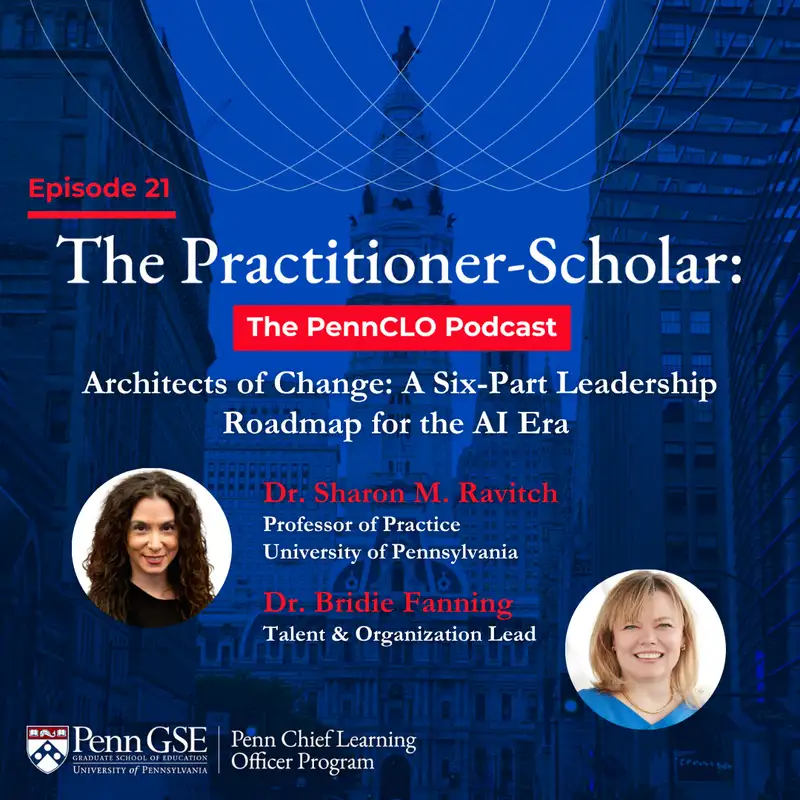
Architects of Change: A Six-Part Leadership Roadmap for the AI Era
In this episode of The Practitioner Scholar, Dr. Sharon Ravitch sits down with Dr. Bridie Fanning, Managing Director at Accenture and former Chief HR Officer, to discuss her critical contributing chapter to the ground-breaking new book, Leaders as Architects of Change (edited by Dr. Sharon Ravitch and Dr. Raghu Krishnamoorthy). While modern headlines focus heavily on what artificial intelligence can automate, Dr. Bridie Fanning argues that the future of work will not be dictated by technology, but by leadership choices. This conversation dives deep into her chapter's core ethos: that AI is fundamentally a human learning story, that leaders must build psychological safety for continuous experimentation, and that traditional, linear change management models must be entirely rewritten to align with the framework of the book.
Key Takeaways:
- Amara’s Law in Action: Why we are currently overestimating AI's short-term hype while drastically underestimating its massive, long-term societal and operational impact.
- The Death of Traditional Change Management: Moving away from traditional "Point A to Point B" transition models and adopting dynamic, continuous, and iterative organizational capabilities.
- The "Inverted" Problem-Solving Approach: Why leaders must stop asking "What can AI do?" and instead start with their biggest organizational pain points, working backward to find technical solutions.
Creators and Guests

Host
Dr. Sharon M. Ravitch
Dr. Sharon Ravitch is a professor of practice at the University of Pennsylvania Graduate School of Education. Ravitch’s research, advising, teaching, and learning design integrate human and organizational development, psychology, anthropology, leadership, management, and organizational theory. Ravitch is a GIAN Scholar of the Government of India and Fulbright Specialist. Ravitch is a global leadership and organizational diagnostics expert working with leaders, teams, and organizations to cultivate organizational sensemaking practices for cultural excellence. She teaches and coaches executives across sectors and global contexts, designing and conducting leadership development with global leaders at the Wharton Business School’s Executive Education hub and the Yale School of Management. Ravitch’s approach to sustainable, assets-based organizational development and applied research is grounded in her decades-long experience serving as a senior advisor to global executives, leaders, and policymakers across government, corporate, non-profit, and non-governmental sectors working to drive sustainable change at the individual, community, state, and national levels. Dr. Ravitch has published nine books on leadership and qualitative methods including: Leaders as Architects of Change: Designing Organizations for Connection and Resilience in Times of Uncertainty (2026); Leadership Mindsets for Adaptive Change: The Flux 5 (2023); Flux Leadership: Real-Time Inquiry for Humanizing Educational Change (2022); Qualitative Research: Bridging the Conceptual, Theoretical, and Methodological (2021/2016); Applied Research for Sustainable Change: A Guide for Education Leaders (2019); Reason and Rigor: How Conceptual Frameworks Guide Research (2017/2012); Matters of Interpretation: Reciprocal Transformation in Therapeutic and Developmental Relationships with Youth (1998). Her two current books focus on humanizing AI in organizations and systems. Ravitch earned two master’s degrees from Harvard University in Human Development and Psychology, mentored by Dr. Carol Gilligan, and a doctorate from the University of Pennsylvania in anthropology and education

Guest
Dr. Bridie Fanning
Dr. Bridie Fanning is a practitioner-scholar who has spent her career on the people side of large, complex business transformation. Today she is a Managing Director at Accenture, where she leads the talent and organization implications of large AI and enterprise transformations: strategic workforce planning, skills-based organization design, and preparing leaders and teams to learn and work alongside AI. Before Accenture, Bridie served as Chief Human Resources Officer six times, reporting to the CEO at Vyaire Medical, Surgical Care Affiliates, Softcard (the AT&T, Verizon and T-Mobile mobile wallet venture acquired by Google), Fiserv, NCR and GE Consumer Finance (now Synchrony). She built HR functions from scratch, integrated major acquisitions, and partnered with boards on leadership succession and executive compensation. Her career has taken her across the UK, Switzerland, Poland, the Czech Republic and the United States. Bridie is the author of “Leadership in the Age of AI: Skills, Systems, and Mindsets for a Digitally Rewired Workplace,” Chapter 2 of Leaders as Architects of Change (Routledge, 2026). Her central argument is that AI will not determine the future of work; leaders will. She believes learning and talent leaders are among the most important architects of that future, because they build an organization’s capacity to adapt. She holds an Ed.D. from the University of Pennsylvania’s Chief Learning Officer program, where her dissertation examined how companies have adapted learning for the new digital age.


Producer
Dr. Raghu Krishnamoorthy
Dr. Raghu Krishnamoorthy is a scholar-practitioner whose 40-year career spans corporate HR leadership and doctoral education. From 2022 to 2026 he was Senior Fellow and Director of the University of Pennsylvania's Chief Learning Officer (PennCLO) doctoral program. There he shaped the curriculum, led faculty and admissions, and chaired dissertations on leadership, learning, and the future of work. He has also taught at Wharton and been guest faculty at Harvard Business School, MIT Sloan, Yale, and Columbia. Before moving into academia, Raghu spent 25 years at General Electric, with HR roles in India, Hong Kong, London, and the United States. He was CHRO of GE Aviation, Chief Talent and Learning Officer at Crotonville, GE's leadership institute, and CHRO of GE Healthcare. He then became Chief Human Resources Officer of GE, leading HR for a $120 billion company with an HR organization of 4,000 people. Earlier in his career he held HR roles at American Express Bank, Modi-Xerox, and Escorts in India. His research looks at the future of work, the workplace, and the worker. His doctoral dissertation, on how leader behaviors affect employee engagement in virtual work, was awarded distinction, and his research won the Academy of Business Research's Best Paper Award in 2020. He writes often for Harvard Business Review and co-edited Leaders as Architects of Change (Routledge, 2026) with Sharon Ravitch. Raghu has advised and consulted with several organizations, including Boeing, Kraft Heinz, Tech Mahindra, Takeda, and the Tata Group. He sits on the board of IIM Ahmedabad's Ashank Desai Center for Learning and Organizational Development. He holds an Ed.D. and M.S.Ed. from Penn and an MBA from IIM Ahmedabad and was a Hubert H. Humphrey Fellow under the Fulbright program.